
Veterinary graduates today face an exciting crossroads. The traditional path of clinical practice is no longer the only option, or even the most profitable one. With India's booming pharmaceutical, animal nutrition, and agribusiness sectors, veterinary students have four distinct pathways to corporate success. Each offers different salary trajectories, growth opportunities, and lifestyle tradeoffs. This blog breaks down all four routes, the challenges you'll face, and which path suits your profile best.
PART 1: THE MASTER'S DEGREE ROUTE
Direct Career Acceleration in Specialized Sectors
Why a Master's Makes Sense
A specialized master's degree transforms you from a generalist veterinarian into a sector specialist that corporate companies actively recruit. Instead of competing with general graduates, you become an expert in a defined niche, and that expertise commands premium salary packages.
1. Pharmacology & Pharmaceutical Management
Target Companies & Roles:
- Boehringer Ingelheim, Zoetis, Merck Animal Health, Elanco
- Cipla, Lupin Pharma (Animal Health Division), ASPPL
- Roles: Regulatory Affairs, Quality Assurance, Product Manager, Clinical Research Associate
Salary Expectations (2024-2025):
- Entry Level (Post-Master's): ₹6.5 LPA - ₹8.5 LPA
- After 3 years: ₹10 LPA - ₹13 LPA
- After 5 years: ₹14 LPA - ₹18 LPA
- International opportunities (US/EU): $65,000 - $85,000 USD annually
Growth Trend: The Indian veterinary pharmaceutical market is growing at 9-11% CAGR (Compound Annual Growth Rate) as of 2024. Global animal health market is valued at $50 billion and expected to reach $65 billion by 2028.
2. Animal Nutrition & Feed Industry
Target Companies & Roles:
- Cargill, Purina (Nestlé), Godrej Agrovet, Growel Agrovet, Dena Feed
- Companies like BRF, Trident, Suguna Group
- Roles: Nutritionist, Product Development Manager, Quality Manager, Sales Manager (Technical)
Salary Expectations (2024-2025):
- Entry Level (Post-Master's): ₹6 LPA - ₹8 LPA
- After 3 years: ₹9 LPA - ₹12 LPA
- After 5 years: ₹12 LPA - ₹16 LPA
- International (Southeast Asia, Middle East): $55,000 - $75,000 USD
Growth Trend: India's animal feed market is projected to grow at 8.5% CAGR through 2028, driven by increasing meat consumption and dairy expansion. The premium segment (specialty feeds for aquaculture and poultry) is growing at 15% CAGR.
3. Livestock & Production Management (LCT Specialization)
Target Companies & Roles:
- Meat Industries: BRF, Suguna Group, Godrej, Fresh & Pure
- Dairy: ITC Astalife, Amul Corporate, Britannia Animal Products
- Roles: Production Manager, Quality Assurance Manager, Technical Manager, Operations Head
Salary Expectations (2024-2025):
- Entry Level (Post-Master's): ₹6.5 LPA - ₹8 LPA
- After 3 years: ₹10 LPA - ₹13 LPA
- After 5 years: ₹13 LPA - ₹17 LPA
- Management level (8+ years): ₹20 LPA - ₹30 LPA
Growth Trend: India's meat and poultry market is valued at approximately ₹2 trillion and growing at 10% annually. Meat exports are increasing, with poultry exports reaching 280,000 tonnes in 2022-23. The sector is rapidly modernizing and professionalizing.
4. Diagnostic & Pathology Services
Target Companies & Roles:
- VETSCAN, Kiran Diagnostics, Hi-Tech Institute, C-DAC
- Veterinary pathology labs and contract research organizations
- Roles: Diagnostic Specialist, Lab Manager, Quality Auditor
Salary Expectations (2024-2025):
- Entry Level (Post-Master's): ₹5.5 LPA - ₹7 LPA
- After 3 years: ₹8 LPA - ₹10 LPA
- After 5 years: ₹10 LPA - ₹14 LPA
PART 2: THE MBA ROUTE
Building Business Acumen for Management Roles
Why Veterinary Graduates Choose MBA?
While a master's in veterinary science deepens technical expertise, an MBA positions you for leadership roles. If your goal is to become a VP of operations, Business Head, or Regional Manager within 8-10 years, an MBA is your accelerator.
The MBA Pathway for Veterinary Graduates
Step 1: Entrance Examinations
A. CAT (Common Admission Test)
What is CAT?
- National level entrance exam for MBA admission across India
- Administered by IIMs and AACTE
- Qualifying score: 90+ percentile typically required for top colleges
- Test Duration: 120 minutes (online, adaptive)
CAT Exam Structure:
- Quantitative Aptitude & Data Interpretation: 60 minutes
- Verbal Ability & Reading Comprehension: 60 minutes
- Overall: 100 questions, 120 minutes
Difficulty Level: CAT is challenging for veterinary students because:
- Heavy focus on mathematics (your weak point?)
- Requires strong English and comprehension skills
- Logical reasoning sections are conceptually different from veterinary education
Challenge for Veterinary Students:"My maths is weak, can I crack CAT?" This is the most common concern. The answer: Yes, but it requires dedicated 6-12 months of preparation. Many veterinary students have scored 95+ percentile, but it requires consistent effort in quantitative sections.
CAT Preparation Timeline:
- If your math foundation is weak: 12-14 months preparation
- If you have moderate math background: 8-10 months
- If you're comfortable with math: 4-6 months
Registration & Test Dates:
- Typically held in November-December
- Registration deadline: September-October
- Registration fee: ₹2,200 (General/OBC), ₹1,100 (SC/ST)
B. XAT (Xavier Aptitude Test)
Comparison with CAT:
- Slightly different exam structure
- More emphasis on decision-making
- 75+ percentile required for good colleges
- Good alternative if CAT scores are disappointing
XAT Structure:
- Verbal Ability & Logical Reasoning
- Quantitative Ability & Data Interpretation
- Decision Making (unique feature)
- General Knowledge
- Essay Writing
C. GMAT (for international MBA)
Note: See Part 4 for GMAT details as it requires 2 years of work experience.
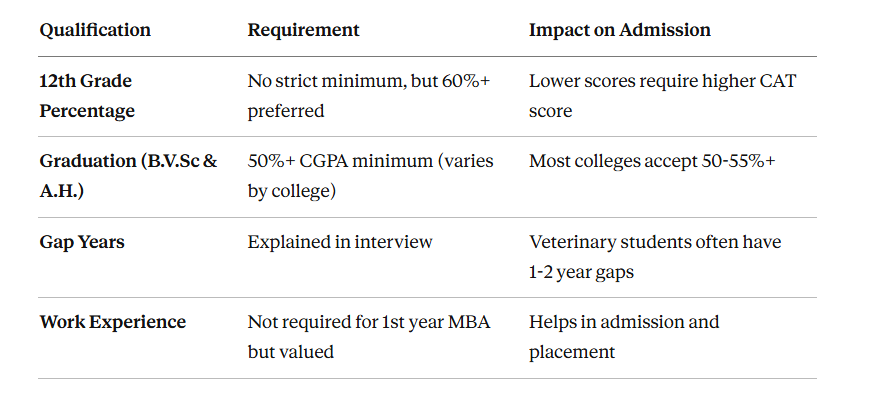
Step 2: Academic Qualifications & Eligibility
Standard Requirements for MBA Admission:
Step 3: The Gap Year Challenge
Veterinary Education Reality:
- Many students take 1-2 year gaps to prepare for NEET post-graduation
- Some take gaps after 12th for NEET preparation
- This is a significant concern during MBA interviews
How to Address Gap Years in Interviews:
Example Explanation:"After my 12th, I took a one-year gap to focus on NEET preparation and strengthen my science fundamentals. This gap helped me build discipline and problem-solving skills. Subsequently, I invested my post-graduation gap year in veterinary clinical practice and understanding animal healthcare industry trends, which has given me practical insights into the sector I want to transform through business management."
Better Framing:
- Position gaps as deliberate career-building, not lack of planning
- Mention skills learned during gap (online certifications, internships, volunteer work)
- Connect gap experience to why MBA is necessary
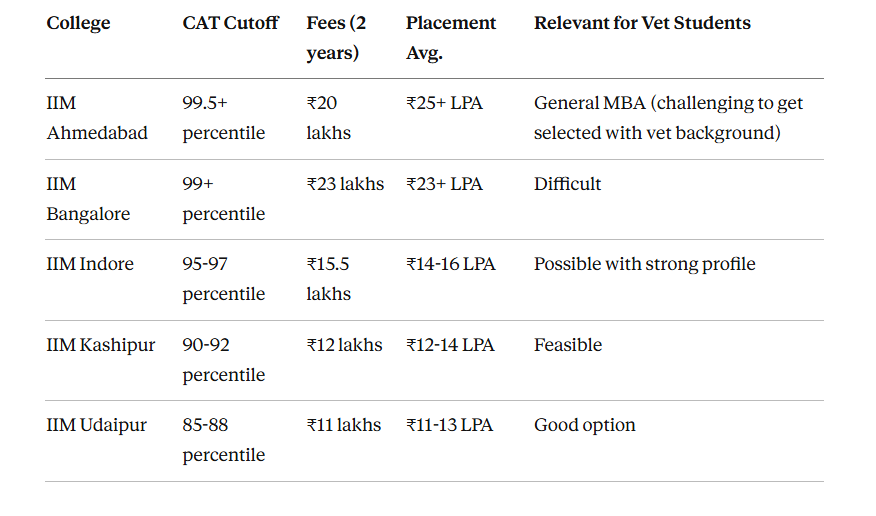
Step 4: Top MBA Colleges Accepting Veterinary Graduates
PART 3: THE DIRECT JOB ROUTE
Start Earning Immediately, Build Experience Fast
The Immediate Entry Strategy
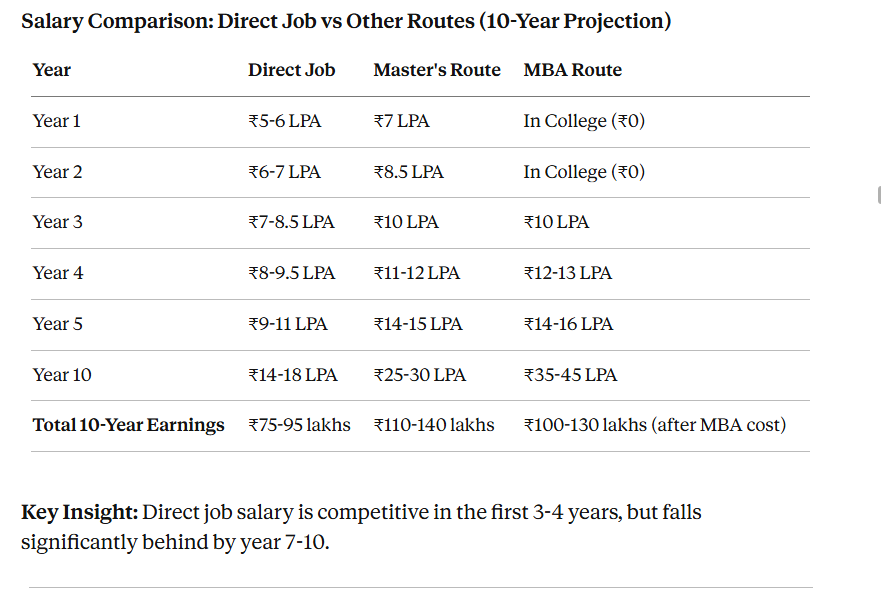
If you're eager to start your career, hate studying further, or don't want to wait 2 more years, the direct job route offers the fastest entry into corporate India. You'll start lower but can climb quickly with strategic moves.
Corporate Sectors Hiring B.V.Sc Graduates Directly
1. Pharmaceutical Companies
Entry-Level Positions:
- Medical Representative (MR) / Technical Sales Representative
- Quality Assurance Executive
- Regulatory Affairs Associate
- Clinical Research Associate (CRA)
- Production Executive
Typical Salary (2024-2025):
- Base salary: ₹3.5 - ₹4.5 LPA
- With incentives/commission: ₹4.5 - ₹6 LPA
- Total compensation: ₹5 - ₹6.5 LPA
Growth Path:
- After 2 years → Senior MR / QA Officer: ₹6 - ₹8 LPA
- After 4 years → Area Manager / Senior Executive: ₹8 - ₹11 LPA
- After 6 years → Regional Manager / Manager: ₹12 - ₹16 LPA
- After 8+ years → Area Business Manager / Senior Manager: ₹18 - ₹25 LPA
Major Recruiters: Boehringer Ingelheim, Zoetis, Cipla, Lupin, ASPPL, Merck, Elanco
2. Animal Nutrition & Feed Companies
Entry-Level Positions:
- Field Sales Executive
- Technical Officer (Feed Mill)
- Quality Control Officer
- Production Support Executive
Typical Salary (2024-2025):
- Base salary: ₹3.5 - ₹4.5 LPA
- Total compensation: ₹5 - ₹6 LPA (lower than pharma due to lower margins)
Growth Path (Slower than Pharma):
- After 2 years → Senior Technical Officer: ₹5.5 - ₹7 LPA
- After 4 years → Area Manager: ₹7 - ₹9.5 LPA
- After 6+ years → Regional Manager: ₹10 - ₹14 LPA
Why Slower Growth: Feed industry has lower margins than pharmaceuticals and slower professionalization.
Major Recruiters: Cargill, Godrej Agrovet, Growel Agrovet, Dena Feed, Purina
3. Livestock & Meat Processing Companies
Entry-Level Positions:
- Production Supervisor
- Quality Officer
- Herd Manager / Animal Care Manager
- Technical Support Officer
Typical Salary (2024-2025):
- Base salary: ₹3.5 - ₹4.5 LPA
- Total compensation: ₹4.5 - ₹5.5 LPA
Growth Path (Location dependent):
- After 2 years → Senior Supervisor: ₹5.5 - ₹6.5 LPA
- After 4+ years → Manager/Shift In-Charge: ₹7 - ₹10 LPA
Challenges: Often requires relocation to production sites (usually not metro cities). Shift work common.
Major Recruiters: Suguna Group, BRF, Godrej, ITC Astalife, Fresh & Pure
The Real Challenges You'll Face
1. Entry-Level Struggles
Challenge A: Lack of Management Respect
- You're competing with MBA/CA/CS graduates in some companies
- Ceiling without further qualifications is often middle management
- Senior management positions (VP+) are rare without MBA
Challenge B: Learning Curve
- Corporate processes are very different from academic learning
- You'll make mistakes; that's normal but can be demoralizing
- First 6 months are the hardest (adjusting to corporate culture)
Challenge C: Limited Lateral Movement
- Hard to switch sectors without specialized degree (e.g., pharma → consulting)
- If you want to move to non-veterinary sectors, you'll face credential barriers
2. Career Ceiling Issues
Without Further Qualifications:
- Typical ceiling in pharma: Regional Manager (₹18-25 LPA)
- Typical ceiling in feed industry: Area Manager (₹12-16 LPA)
- Typical ceiling in livestock: Unit Manager (₹10-14 LPA)
- These ceilings are reached around 10-15 years of experience
To Break Beyond:
- Most VPs/Directors have MBA or Executive MBA from top colleges
- Without these, advancement becomes slow after 8-10 years
3. The MR Trap
Important Warning: If you start as a Medical Representative (MR), be very strategic about your progression.
- MR roles offer decent salary (₹5-6 LPA) and commission
- But MRs often get "stuck" in that position
- It takes deliberate effort and additional qualifications to move into management
Smart MR Strategy:
- Perform exceptionally in first 2 years (top 10% in your company)
- Simultaneously pursue distance MBA or online business courses
- After 2 years, apply for Area Manager or Operations roles
- Target companies that promote MRs to management regularly
PART 4: THE WORK + GMAT + ISB ROUTE
The Premium International Business Education Path
Why GMAT and ISB?
While CAT-based MBA is Indian-focused, GMAT opens doors to globally recognized MBAs. ISB (Indian School of Business) is India's most prestigious business school with global standards and placements. This route combines work experience with world-class business education.
The GMAT Requirement & Eligibility
What is GMAT?
Overview:
- Graduate Management Admission Test
- Accepted globally for MBA applications
- Conducted by GMAC (Graduate Management Admission Council)
- Score validity: 5 years
- Required for ISB and most international MBAs
GMAT Eligibility for Veterinary Graduates
Official Requirements:
- Minimum age: 18 years
- Maximum age: No limit
- Bachelor's degree completion (you have B.V.Sc & A.H.)
- No specific work experience required for GMAT test itself
BUT → ISB (and most top international MBAs) require:
- 2 years of post-graduation professional work experience (mandatory)
- Some schools like ISB prefer 3-5 years
- Experience should be in substantive professional role (not internships)
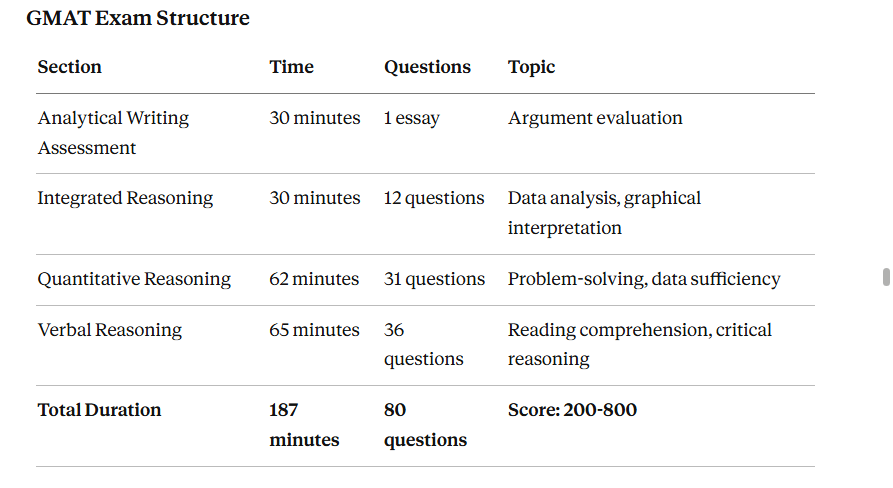
Difficulty: GMAT is harder than CAT but tests different skills. It focuses on business reasoning rather than pure mathematics.
Score Requirements
For ISB (Hyderabad):
- Average GMAT score: 705-720
- Minimum acceptable: 650
- But competitive applicants score 700+
For ISB Executive MBA:
- Average score: 680-700
- Minimum: 620
- More lenient as candidates have 3-5 years experience
International MBAs (US/UK):
- Top 20: 680-740
- Good MBAs: 650-700
- Moderate MBAs: 600-650
Why Work Experience is Mandatory
ISB's Perspective: ISB explicitly requires 2+ years of professional experience because:
- Case-based MBA curriculum requires real-world business context
- Peer learning (ISB value-add) requires diverse professional backgrounds
- International MBA is for mid-career professionals, not fresh graduates
Veterinary Student Advantage: Unlike general graduates, your veterinary work experience is highly valued because:
- You understand animal health industry deeply
- You can bring sector-specific case studies to classroom
- You're not competing with IT/finance graduates (less crowded category)
PART 5: COMPREHENSIVE COMPARISON & RECOMMENDATIONS
Which Path Should YOU Choose?
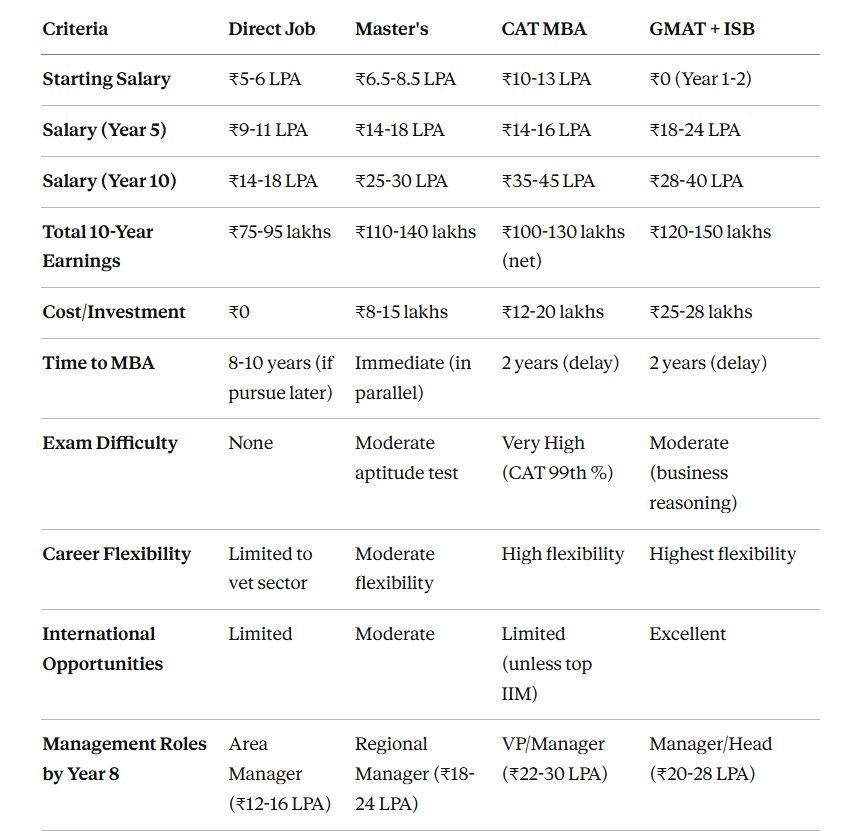
Side-by-Side Comparison of All Four Routes
CONCLUSION
The Most Reliable Path for Most Veterinary Graduates:
MASTER'S DEGREE ROUTE emerges as the most balanced option because:
- Higher starting salary than direct job (₹6.5-8.5 vs ₹5-6 LPA)
- Specialization is valued in animal health sector (vs general MBA)
- Lower exam stress than CAT (vs 99th percentile requirement)
- Affordable (₹8-15 lakhs vs ₹25-28 lakhs for ISB)
- Flexible future (can pursue MBA later, or executive MBA part-time)
- 2-year opportunity is reasonable investment for 10-year career gains
- Sector expertise becomes your differentiator as you advance
Exception: If you're extremely ambitious, excellent at exams, and dream of being CEO → pursue CAT-based MBA from top IIM
Another Exception: If you want global career mobility → pursue WORK + GMAT + ISB
But for the majority: Master's degree offers the best risk-adjusted return and positions you well for future advancement.
References & Data Sources
1. Salary Data
- ICAR-Indian Veterinary Research Institute (IVRI) – ASPIRE Survey on Veterinary Graduates (2024)
- Pharmaceutical Research and Manufacturers of America (PhRMA) – Global Animal Health Market Report (2024)
- Alltech – Global Feed Survey (2023)
- Ministry of Animal Husbandry & Dairying (DAHD) – Government Salary & Employment Data
2. Industry Growth & Market Analysis
- Federation of Indian Chambers of Commerce & Industry (FICCI) – FICCI–McKinsey Animal Healthcare Report (2023)
- Department of Animal Husbandry & Dairying Annual Report – (2023–24)
- ICRA Limited – Indian Poultry Industry Report (2024)
- Agricultural and Processed Food Products Export Development Authority (APEDA) – Poultry Export Data
- Associated Chambers of Commerce and Industry of India (ASSOCHAM) – Livestock Sector Report
3. Entrance Exams & MBA Institutions
- Common Admission Test (CAT) – Official Portal & Statistics
- Xavier Aptitude Test (XAT) – Official Website
- Indian Institute of Management Ahmedabad – Placement Reports
- Faculty of Management Studies (FMS), Delhi – Placement Data
- Xavier School of Management (XLRI), Jamshedpur – Placement Reports
4. Agricultural & Veterinary MBA Programs
- ICAR-Indian Agricultural Research Institute (IARI) – Agribusiness Management
- Narendra Deva University of Agriculture & Technology (NDUAT) – Dairy & Livestock Business
- Tamil Nadu Agricultural University (TNAU) – Agribusiness Programs
5. GMAT & International MBA
- Graduate Management Admission Council (GMAC) – GMAT Portal
- Indian School of Business (ISB) – Admissions & Placement Statistics
- QS World University Rankings (MBA) – Global Rankings
6. Job Market & Salary Trends
- LinkedIn Talent Solutions – Salary Insights (2024)
- Indeed Career Guide – Salary Data
- Payscale India – Compensation Trends
- Labour Bureau, Government of India – Employment Data
7. Corporate Career Sources
- Boehringer Ingelheim – Animal Health Careers
- Zoetis – Veterinary Pharmaceutical Careers
- Cargill – Agribusiness Careers
- Godrej Agrovet – Livestock Industry Careers
8. Government & Regulatory Sources
- Ministry of Animal Husbandry & Dairying (DAHD) – Policies & Reports
- Indian Council of Agricultural Research (ICAR) – Research & Veterinary Data
- Livestock Census, Government of India – National Livestock Data
.jpg)