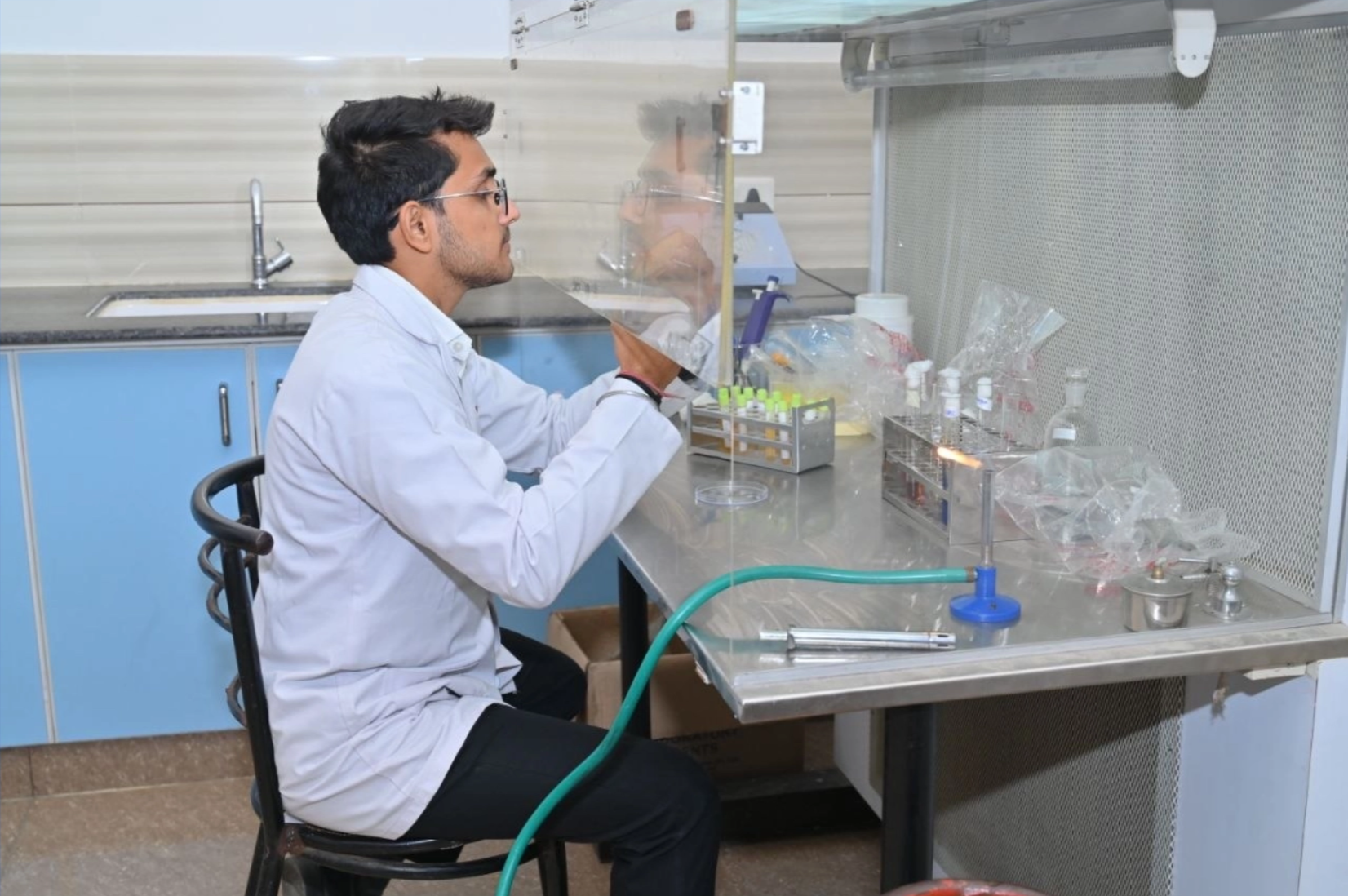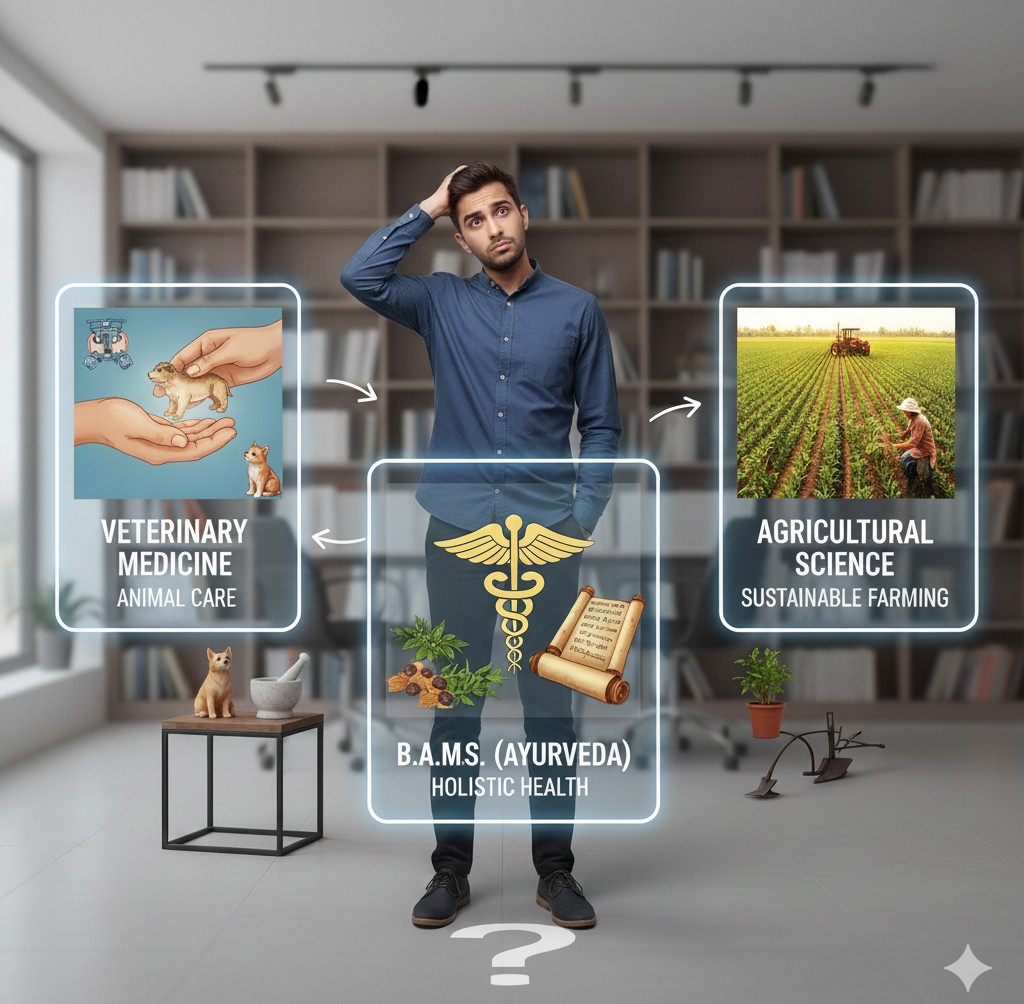

Choosing a career path after 12th grade is a crucial moment, especially when you have three such distinct, yet equally important, options within the life and medical sciences. While all three, Bachelor of Ayurvedic Medicine and Surgery (BAMS), Bachelor of Veterinary Science & Animal Husbandry (BVSc-AH), and Bachelor of Science in Agriculture (BSc Agriculture) are noble professions, they cater to fundamentally different interests, skill sets, and career aspirations. This guide moves beyond simple comparisons to help you match your deepest passions to the profession that awaits.
Bachelor of Ayurvedic Medicine and Surgery BAMS: (5.5 Years)

BAMS degree focuses squarely on human health, holistic healing, traditional medicine, and pharmacology. It is a rigorous, 5.5-year commitment, including a mandatory internship, positioning you as a medical professional prepared to blend ancient wisdom with modern diagnostic tools.
Personal Fit and Career Path
The ideal BAMS aspirant is the Holistic Healer: a person characterized by patience, strong communication skills, deep empathy, and a keen interest in the history and philosophy of medicine. You must be a great listener and keen observer of subtle physiological changes, prepared for a patient-centric, time-intensive practice.
The career landscape for BAMS is experiencing a significant Wellness Boom. Graduates can work as Ayurvedic Practitioners in private clinics, Research Officers, Medical Officers in Government Hospitals, or as Wellness Consultants in luxury spas and resorts. This growth is strongly supported by government initiatives like AYUSH and a growing global preference for natural remedies.
Financially, opportunities are solid: Entry-Level Government roles typically pay ₹4.5 - 7 LPA, while successful private practitioners in metro cities can earn significantly more, often ranging from ₹10 - 25+ LPA depending on reputation and specialization.
Global and Educational Landscape
Globally, BAMS holds a limited but growing scope in Western countries due to licensing hurdles, but it is highly sought after in regions with large Indian/South Asian diaspora and those embracing Medical Tourism and Integrative Medicine (e.g., UAE, certain EU nations).In India, BAMS is highly competitive, similar to MBBS/BDS. Securing one of the ~50,000+ total seats across the ~450+ colleges requires a top NEET score, generally demanding 400-550+ marks for a decent government seat, depending on the state and category.
Bachelor of Veterinary Science & Animal Husbandry BVSc-AH:(5.5 Years)

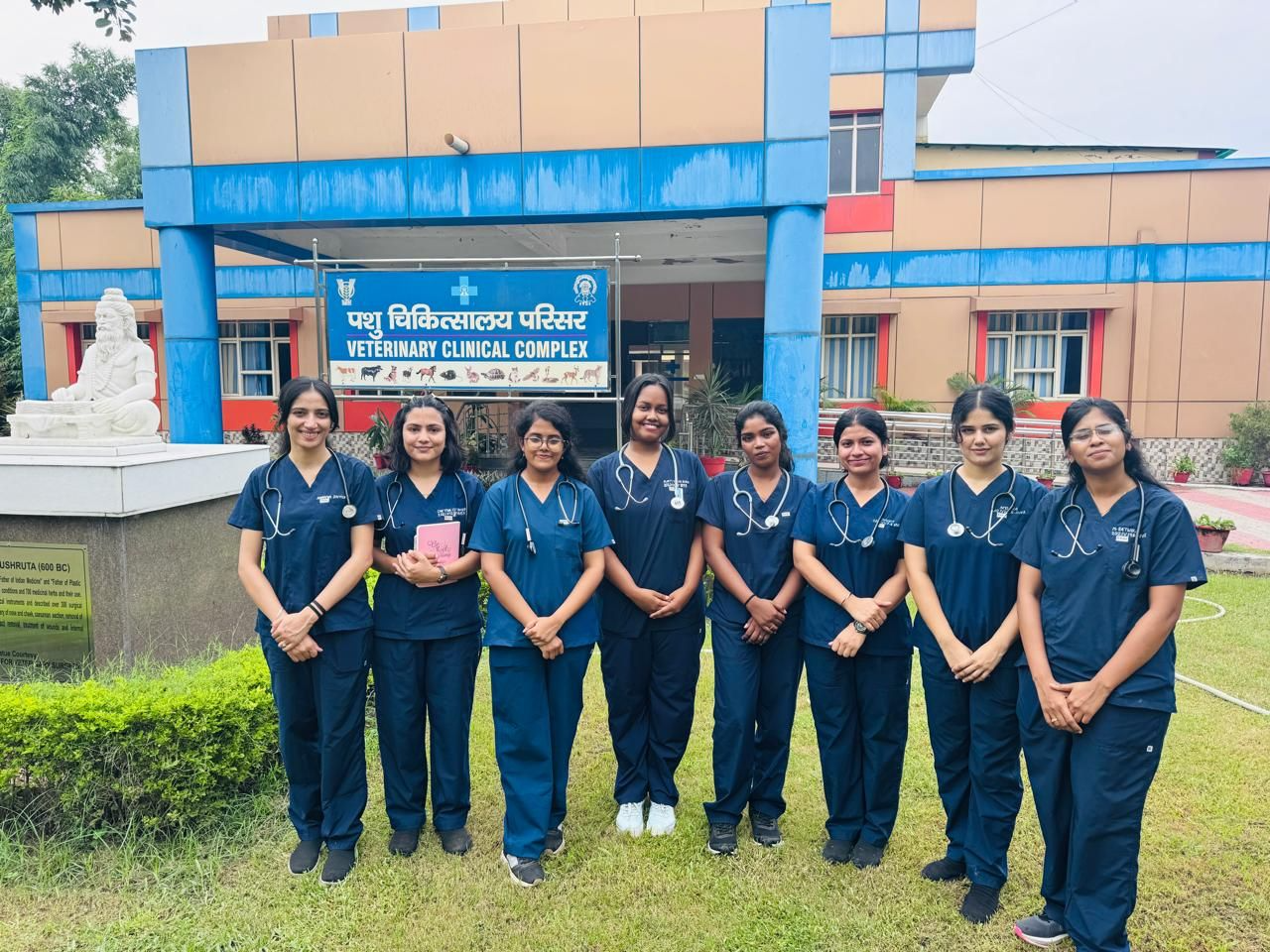
The BVSc-AH degree is also a 5.5-year commitment, including an internship, and focuses on animal health, covering pets, livestock, and exotic species,surgical practices, epidemiology, livestock management, and crucial public health work under the "One Health" concept.
Personal Fit and Career Path
The ideal BVSc-AH student is the Dedicated Advocate: characterized by deep compassion for animals, physical stamina (as you'll often deal with large or uncooperative animals), sharp problem-solving skills (since your patients can’t speak), and strong resilience to emotional stress. This profession demands comfort working in clinical, farm, and field settings.
The career demand here is extremely high. Vets are not just pet doctors; they are essential in food safety, livestock economics, and controlling zoonotic diseases. Job roles include Veterinary Surgeon, Animal Husbandry Officer (Government), Zoo Veterinarian, Poultry/Dairy Consultant, and Food Safety Inspector. The "One Health" initiative ensures continuous investment and job creation.
Salary prospects are excellent, especially for specialists. Entry-Level Government Officer positions start around ₹6 - 10 LPA. Private practice, particularly in companion animal care in large cities, is highly lucrative, often reaching ₹12 - 30+ LPA for specialists.
Global and Educational Landscape
Global opportunities are excellent for BVSc-AH graduates. Degrees from accredited Indian universities are well-recognized internationally, opening doors for post-graduate studies (MS, PhD). Licensing exams (like NAVLE in North America) allow practice abroad, driven by the Global Pet Care Industry Boom and international disease control efforts.
Competition is intense due to the limited number of seats. There are only about ~70+ colleges offering BVSc-AH with a low ~3,000 - 4,000 total seats. Admission usually relies on NEET scores (or state equivalents), typically requiring 350-500+ marks for a coveted government college spot.
BSc Agriculture(4 Years)
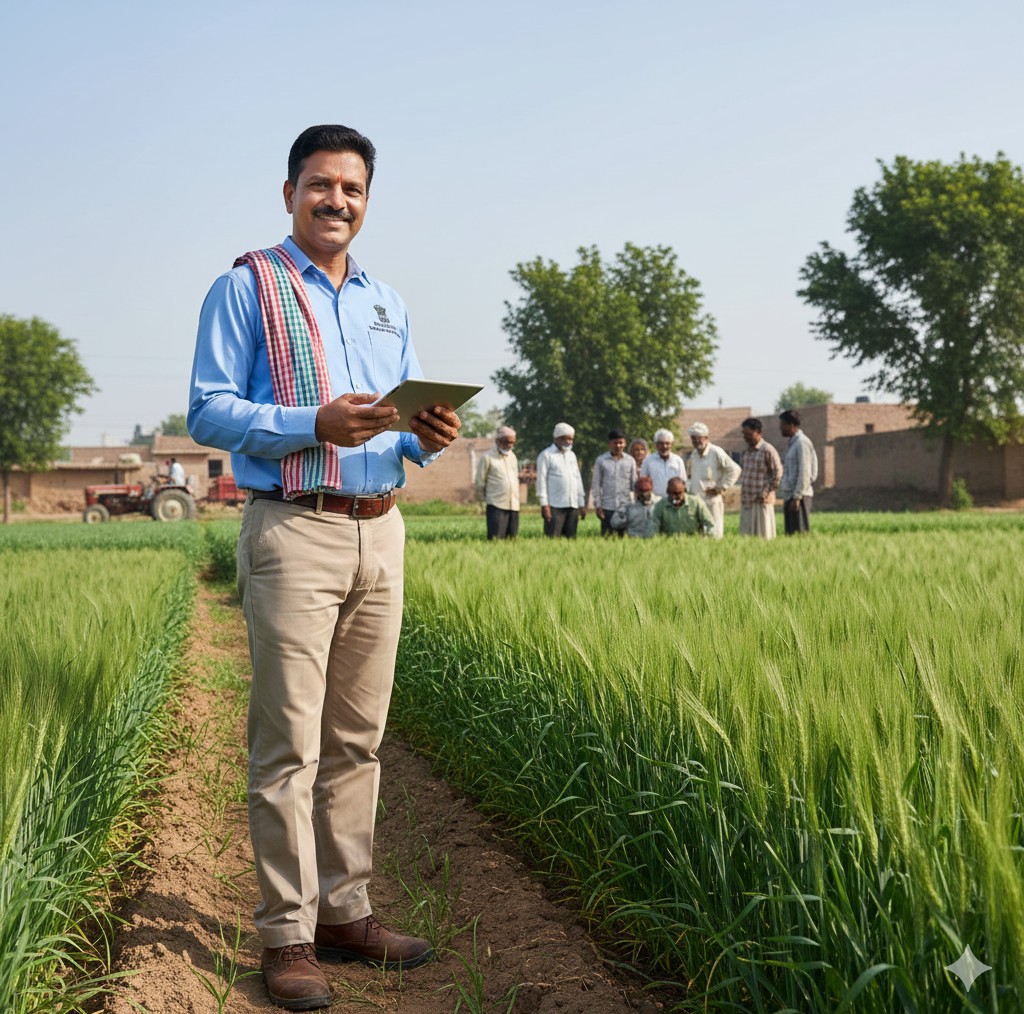
The BSc Agriculture degree is a 4-year, highly technical program focusing on crop science, soil science, farming economics, precision agriculture, food technology, and sustainable resource management. It is the key to feeding the future population efficiently.
Personal Fit and Career Path
The ideal BSc Agriculture student is the Innovation Manager: someone with practicality, an entrepreneurial spirit, comfort with technology (drones, sensors, data analysis), and a willingness to get hands-on in a field environment. This field combines science, technology, and business management.
Career prospects are very high and stable, driven by the need to increase efficiency and sustainability. Graduates find roles as Agricultural Field Officers (AFO) in Banks (a guaranteed job avenue), Farm Managers, Research Scientists (ICAR/Private Seeds), Agri-Business Consultants, and Marketing Managers for fertilizer/seed companies. The future is focused on Precision Farming, Sustainable Agriculture, and Agri-Tech Startups.
Starting salaries are competitive, with Entry-Level Government/AFO roles ranging from ₹5 - 9 LPA. Private sector and Agri-Tech roles are often highly growth-oriented, starting around ₹6 - 12 LPA.
Global and Educational Landscape
Global study and work opportunities are very good. Developed economies (USA, Canada, Australia) have high demand for specialization in Food Security, Agronomy, and AI-driven Crop Management.
In India, this degree is governed by the ICAR-AIEEA (Central) or State Exams/NEET rankings. With ~400+ colleges and ~30,000+ seats, entry is generally more varied than the highly competitive BAMS or BVSc-AH, requiring scores in the 300-450+ range for top ICAR institutes.
Final Verdict: Ask Yourself These Questions
Ultimately, the choice comes down to you:
What is your interest?
- If your deepest empathy is for humans and holistic medicine, choose BAMS.
- If your passion is for the well-being of animals and you are ready for high-level diagnostics and field work, choose BVSc-AH.
- If your calling is solving global food and technology challenges and improving the economic output of land, choose BSc Agriculture.
All three are strong, future-proof careers. Match your heart to the mission, and success will follow!

.jpg)